BubbleSenses

Applications

Nanoplastics first, with room to grow

SSBD concentrates dilute particles in a liquid. We are applying it first to plastic particles smaller than 1 µm in water, and the same principle carries over to other targets.

First application

Nanoplastics in water

Our first application. SSBD reports what a particle is made of and what it looks like, from the same deposit, for plastic particles smaller than 1 µm.

  • Environmental water: oceans, lakes, rivers, and storm runoff
  • Drinking water: tap, fountain, and bottled water
  • Process water in food and beverage production, where equipment wear and packaging can shed particles
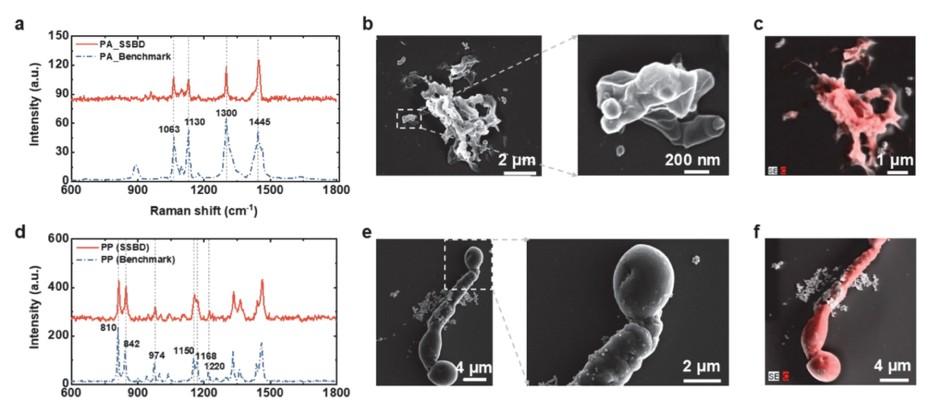
Raman spectra and electron microscope images of polyamide fragments found in bottled water and polypropylene particles found in fountain water.
SSBD results for drinking water: spectra matched to polymer references, with images of the particles. Top, polyamide in bottled water; bottom, polypropylene in fountain water. [2]

Platform

Exposure and health research

Micro- and nanoplastics have been reported in human blood, placenta, brain tissue, and arterial plaque. Studies of dose and effect need measurements that capture particle chemistry and shape at the nanoscale.

  • Polymer identity and morphology from the same deposit
  • Small sample volumes
  • Compatible with Raman and electron microscopes that laboratories already own

Platform

Biosensing

SSBD concentrates dilute particles in a liquid, so the same principle applies beyond plastics. Because the laser is off while the bubble shrinks, biological targets are not exposed to high temperatures; DNA-functionalized nanoparticles survive the deposition intact.

  • Biomarkers such as nucleic acids and extracellular vesicles
  • Waterborne pathogens
  • Custom assays developed with partners

Biocompatible deposition: [3]

Have a sample you want to look at?

We run sample testing and pilot evaluations with laboratories, utilities, and producers.

Request sample testing